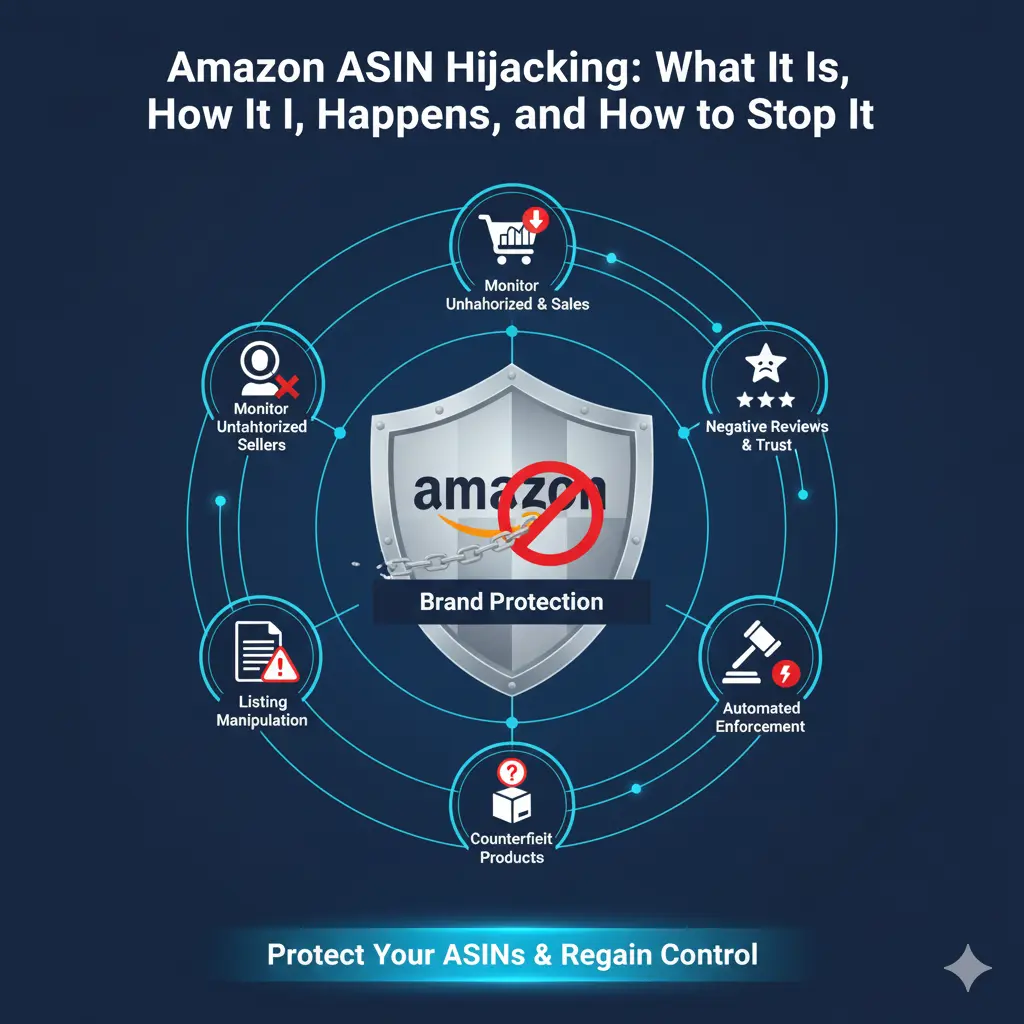
Amazon ASIN hijacking is one of those problems that usually stays invisible until it starts costing you real money.
One day your listing looks fine. Next, you notice unfamiliar sellers, changes to your product detail page, lost Buy Box control, or customer complaints that make no sense for your product. At that point, the damage is already happening, lower conversion rates, refund spikes, and long-term harm to your brand reputation.
In this article, we break down what Amazon ASIN hijacking actually is, how it happens even to Brand Registry sellers, and why reacting late makes recovery harder. More importantly, we’ll walk through practical ways to detect hijackers early and protect your ASINs before they turn into a recurring operational headache.
What is Amazon ASIN hijacking?
Amazon ASIN hijacking is when another seller takes control of your existing Amazon product listing and starts selling on it without your authorization. This usually happens by attaching their offer to your ASIN, changing key listing details, or selling counterfeit or lower-quality versions of your product under your brand name.
As a result, you can lose Buy Box control, see your pricing pushed down, receive negative reviews for products you didn’t sell, and suffer long-term damage to your brand reputation, even though the ASIN originally belongs to you.
How Amazon ASIN Hijacking Happens
Amazon ASIN hijacking usually starts quietly, and that is what makes it dangerous. In most cases, the hijacker does not create a new listing. They attach themselves to an existing ASIN that is already ranking, already trusted by customers, and already generating sales. From Amazon’s system point of view, multiple sellers on one ASIN are allowed, which creates the perfect loophole.
The most common entry point is the Buy Box. A hijacker lists the same ASIN at a lower price, often using a different condition, Fulfilled by Merchant, or questionable Fulfilled by Amazon inventory. Once they win the Buy Box, your sales slow down immediately, even though the listing still looks like yours.
Another common method is listing manipulation. Hijackers may edit product attributes such as title, bullets, images, or variations. This can happen through flat file uploads, partial brand control gaps, or category contribution abuse. Even Brand Registry sellers are not immune if monitoring is weak or edits are missed for days.
There is also the counterfeit angle. Some hijackers sell cheap replicas or low quality versions of your product while using your ASIN, branding, and reviews. Customers think they are buying from you, but receive something else entirely.
In many cases, ASIN hijacking happens because of:
Open contribution categories
Weak monitoring of listing changes
Delayed response to new sellers
No active enforcement process
Assuming Brand Registry alone is enough
What makes this worse is speed. A hijacker can appear, win the Buy Box, generate negative reviews, and disappear within days, leaving your ASIN damaged.
ASIN hijacking is not always aggressive or obvious. Sometimes it looks like a normal seller joining your listing, which is why brands often realize it too late.
Common Signs Your ASIN Has Been Hijacked
The clearest sign of ASIN hijacking is revenue behavior that does not make sense. Your traffic stays the same, impressions look healthy, but conversions drop sharply. This is usually the first red flag.
Buy Box instability is another strong indicator. If you previously held the Buy Box consistently and suddenly lose it to unfamiliar sellers, especially at odd prices, something is wrong. This becomes more obvious when those sellers have limited feedback, new accounts, or mismatched fulfillment methods.
Other warning signs include unexpected listing changes. Titles suddenly include extra keywords. Bullet points shift in tone or accuracy. Images disappear or get replaced. Variations change or break. These edits often hurt conversion rate and organic ranking at the same time.
Customer feedback also tells a story. Watch for reviews mentioning:
Poor quality you do not sell
Packaging you do not use
Missing accessories
Different sizing or materials
Shipping issues you cannot explain
These reviews stick to your ASIN even if you did nothing wrong.
Operational signs matter too:
Increased returns
Buy Box suppression
Price erosion across marketplaces
Complaints from distributors or retail partners
Difficulty enforcing MAP policies
Many brands miss hijacking because they only check Seller Central manually. By the time someone notices, damage has already accumulated.
Hijacking is rarely a single event. It often happens repeatedly to the same ASINs, especially top sellers. That pattern is the clearest sign that prevention and monitoring are missing.
The Real Business Impact of ASIN Hijacking
ASIN hijacking is not just an Amazon issue, it is a business risk. The first impact is lost revenue. When hijackers undercut pricing or take the Buy Box, your sales decline immediately. Even a short hijack can cost thousands in missed revenue on high volume ASINs.
Next comes margin erosion. To compete, brands often drop prices, increase ad spend, or accept lower profitability just to regain visibility. This turns a profitable ASIN into a stressed one very quickly.
Brand damage is the most underestimated impact. Negative reviews caused by counterfeit or poor quality products stay attached to your listing. Even after the hijacker is removed, those reviews continue to hurt conversion rates and trust.
There is also operational drag. Teams waste hours:
Opening Seller Support cases
Collecting evidence
Following up repeatedly
Escalating issues manually
This pulls focus away from growth, launches, and optimization.
For brands with distribution networks, ASIN hijacking creates channel conflict. Authorized resellers get undercut. MAP policies break down. Relationships strain.
Long term, repeated hijacking weakens Amazon authority signals. Rankings fluctuate. Advertising efficiency drops. Recovery takes longer each time.
ASIN hijacking is not just about one bad seller. It is about control, data, and brand integrity. Brands that treat it as a one time problem usually face it again.
How to Prevent and Stop ASIN Hijacking on Amazon
Stopping ASIN hijacking starts with visibility. You cannot protect what you are not watching. Brands need real time monitoring of sellers, price changes, Buy Box ownership, and listing edits across all ASINs.
Prevention means tightening control before problems appear:
Standardize listings and documentation
Track every seller that appears on your ASINs
Monitor Buy Box shifts daily
Watch for silent listing edits
When hijacking happens, speed matters. The faster you detect it, the easier it is to remove the seller and minimize damage. Waiting days or weeks allows reviews, refunds, and ranking loss to pile up.
Enforcement needs structure, not manual chaos. Filing cases one by one without tracking outcomes leads to fatigue and inconsistency. Brands need clear workflows for infringement, counterfeit claims, and unauthorized seller enforcement.
This is where automation becomes critical. Platforms like AxleIT are built to give brands centralized visibility into ASIN level risks, unauthorized sellers, MAP violations, and listing changes in real time. Instead of reacting after damage, brands can act before it spreads.
Prevention is not about fighting Amazon. It is about operating smarter within it. Brands that win long term treat ASIN protection as a system, not a task.
ASIN hijacking will not disappear. But with the right monitoring, enforcement, and tools, it becomes manageable instead of catastrophic.
How AxleIT Helps You Regain Control Over Your ASINs
ASIN hijacking is not something you solve once and forget. It is an ongoing risk that requires constant visibility, fast reaction, and consistent enforcement. Relying on manual checks inside Seller Central or waiting for customer complaints means you are always one step behind the damage.
This is where AxleIT comes in. We built AxleIT specifically for brands that want control back. The platform continuously monitors your ASINs for unauthorized sellers, Buy Box takeovers, suspicious pricing behavior, and listing changes that signal hijacking. Instead of discovering issues days later, you see them as they happen, at the ASIN level, with clear context and evidence.
AxleIT also turns enforcement into a repeatable process. Rather than chasing cases manually, brands use AxleIT to document violations, track outcomes, and maintain consistency across teams and marketplaces. That means fewer surprises, less operational noise, and more time spent growing the business instead of defending it.
If ASIN hijacking is costing you revenue, reviews, or peace of mind, the fix is not more effort, it is better visibility and control. AxleIT helps you protect what you have already built, before hijackers do lasting damage.
