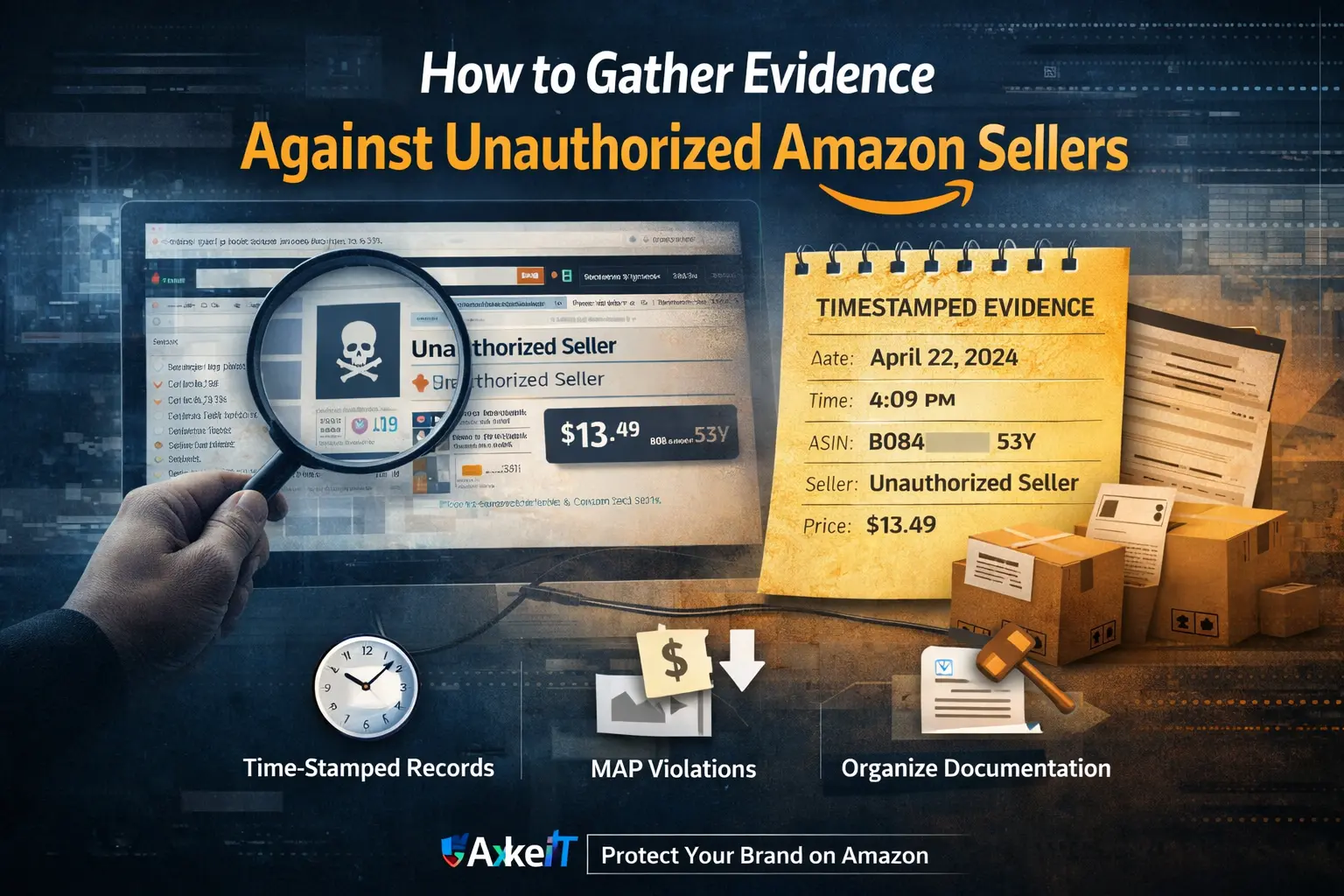
If you run a direct-to-consumer business on Amazon through Seller Central, unauthorized sellers are not just an occasional headache. They interfere with your pricing, disrupt your advertising performance, and put your account health at risk. You may see unknown sellers appear on your listings, undercut your price, or win the Buy Box without warning.
The problem is not noticing it. The problem is proving it.
Most 3P sellers rely on scattered screenshots, manual checks, or occasional reports. That approach breaks down fast. Seller names change.
Offers disappear. Listings update. By the time you escalate an issue, the evidence is incomplete, outdated, or impossible to trace back to a real source. When that happens, enforcement stalls and the same sellers return.
Gathering usable evidence on Amazon requires a structured, repeatable system. You need time-stamped records, seller histories, pricing patterns, and documented violations that connect activity to specific accounts.
In this guide, we’ll walk through how direct-to-consumer sellers can build that evidence properly, what actually holds up in enforcement, and how to move from reacting to problems to controlling them early.
How to Identify Unauthorized Sellers on Your Listings
If you run a direct-to-consumer operation through Seller Central, unauthorized sellers rarely announce themselves. They appear quietly in the “Other Sellers” section, undercut your price, win the Buy Box for a few hours, and disappear before you manually check again.
The first step is clarity.
You need a documented list of:
- Approved seller accounts
- Authorized distributors allowed to sell online
- Region-specific partners
- Any internal secondary accounts
Without that baseline, every new seller becomes a guessing game.
Next, monitor your listings continuously. Manual spot checks once a week are not enough. Unauthorized sellers often rotate in short bursts, which means you miss violations if you are not tracking changes daily or hourly.
Key warning signs:
- Unknown seller names
- Sudden Buy Box loss without price change
- Sellers consistently below your MAP
- Fulfilled by Merchant accounts with unstable stock
- Repeated short-term reappearances
This is where structured monitoring becomes critical. Tools like AxleIT continuously track seller activity at the ASIN level, alerting you the moment a new seller appears or pricing shifts. Instead of discovering violations days later, you get early warnings while evidence is still fresh.
Early detection is not enforcement yet. It is preparation. The faster you identify unauthorized sellers, the stronger your documentation will be later.
How to Capture Time-Stamped Proof That Holds Up in Enforcement
Screenshots alone do not win enforcement cases. Random captures with no timestamps or missing URLs rarely survive review.
If you want action taken, every record must clearly show:
- ASIN
- Full product page URL
- Seller name and ID
- Offer price
- Date and exact time
- Fulfillment type
A proper record includes:
- Screenshot of the Buy Box
- Screenshot of “Other Sellers”
- System clock visible
- Seller profile link saved
- Browser URL fully visible
Avoid cropped images. Avoid edited files. Avoid mobile screenshots if possible.
Even better, archive full-page snapshots so the entire listing layout is preserved.
The challenge for most 3P sellers is consistency. You may capture evidence once or twice, but when violations happen repeatedly across multiple ASINs, manual documentation breaks down.
This is where automation makes a difference. AxleIT automatically logs time-stamped seller activity, pricing changes, and Buy Box shifts. Instead of scrambling to gather proof after damage is done, you already have structured, historical records ready for review.
The goal is simple: build a defensible timeline. Enforcement moves faster when your documentation is organized, consistent, and traceable.
How to Document Pricing Patterns and MAP Violations
One price drop is rarely enough to take action. A pattern of violations is.
If you sell direct on Amazon, your profitability depends on price stability. Unauthorized sellers who repeatedly undercut MAP damage:
- Your Buy Box share
- Your ad efficiency
- Your perceived value
- Your margins
To document MAP violations properly, track:
- Seller name
- Price offered
- Your official MAP
- Date and time
- Duration of violation
- Frequency over time
Instead of isolated screenshots, build a structured timeline.
Example:
- Seller A below MAP twice
- Seller A below MAP four times
- Wins Buy Box twice
- Daily violations
That pattern demonstrates intentional behavior, not an accident.
You should also connect violations to performance impact:
- Drop in Buy Box percentage
- Increase in ad spend
- Decrease in conversion rate
- Margin compression
AxleIT simplifies this by aggregating seller pricing history across time. You can see repeat offenders, recurring undercutting patterns, and duration metrics in one dashboard instead of scattered spreadsheets.
Strong enforcement cases are built on trends, not moments.
How to Trace Seller Activity to Supply Chain Sources
Identifying unauthorized sellers is only half the battle. The real leverage comes from understanding where they are sourcing inventory.
If you operate a DTC model but still work with limited distributors, gray market leaks often originate from:
- Bulk wholesale shipments
- Regional partners
- Overstock resales
- Liquidation channels
- International arbitrage
Start by analyzing seller behavior:
- Which ASINs they sell
- When they appear
- Volume consistency
- Fulfillment method
- Geographic shipping patterns
Then compare that with your internal shipment data.
For example:
Seller X appears consistently in the Midwest
Distributor Y shipped large volumes to the Midwest two weeks earlier
That correlation creates investigative direction.
AxleIT helps surface these patterns by tracking seller activity across multiple ASINs and timeframes. Instead of treating violations as isolated events, you can identify coordinated activity and repeated sourcing behavior.
The goal is internal accountability, not speculation. Once you can trace activity patterns, conversations with distributors become fact-based instead of confrontational.
How to Organize Evidence for Legal and Platform Action
Even strong data fails if it is disorganized.
When you escalate enforcement, your case file should clearly present:
- Summary of the violation
- Timeline of activity
- Seller identification
- Pricing history
- Business impact
- Supporting documentation
Structure matters.
Recommended format:
- ASIN_Case_File
- /Summary
- /Seller_Activity
- /Price_Timeline
- /Screenshots
- /Supply_Correlation
- /Correspondence
Each file should follow consistent naming conventions. Avoid mixing ASINs. Avoid vague file names like “screenshot1.png.”
If your documentation is clean, structured, and time-sequenced, legal teams can act faster.
This is one of the overlooked advantages of using a monitoring platform like AxleIT. Instead of rebuilding cases from scratch every time a seller appears, you already have organized historical records, seller histories, and pricing logs ready for enforcement review.
Unauthorized sellers rely on chaos and inconsistency.
Effective enforcement relies on clarity and structure.
If you operate a direct-to-consumer Amazon business, building that structure is no longer optional. It is operational discipline.
How AxleIT Helps Direct-to-Consumer Sellers Regain Control of Their Amazon Listings
If you are managing your Amazon operation through Seller Central, you already know how time-consuming enforcement can become. Monitoring dozens of ASINs, tracking rotating sellers, documenting price violations, and building evidence manually is not scalable. It pulls your team away from growth and turns brand protection into a constant firefight.
AxleIT was built specifically for direct-to-consumer sellers who need early visibility and enforceable proof, not just alerts.
Instead of relying on manual checks and scattered spreadsheets, AxleIT gives you a centralized system to:
- Detect unauthorized sellers the moment they appear
- Track Buy Box changes and pricing behavior in real time
- Build automatic, time-stamped violation records
- Identify repeat offenders across multiple ASINs
- Monitor patterns that indicate supply leaks
- Organize evidence for fast enforcement
With AxleIT, enforcement stops being reactive. You are no longer discovering problems after margins are damaged and rankings drop. You see instability early, document it properly, and act while it still matters.
Most DTC sellers lose control on Amazon not because they lack policies, but because they lack visibility. AxleIT fills that gap.
If you are serious about protecting your pricing, your listings, and your long-term margins, the next step is seeing the system in action.
Book a live demo with AxleIT and see how you can turn seller chaos into controlled, documented, and enforceable marketplace governance.
