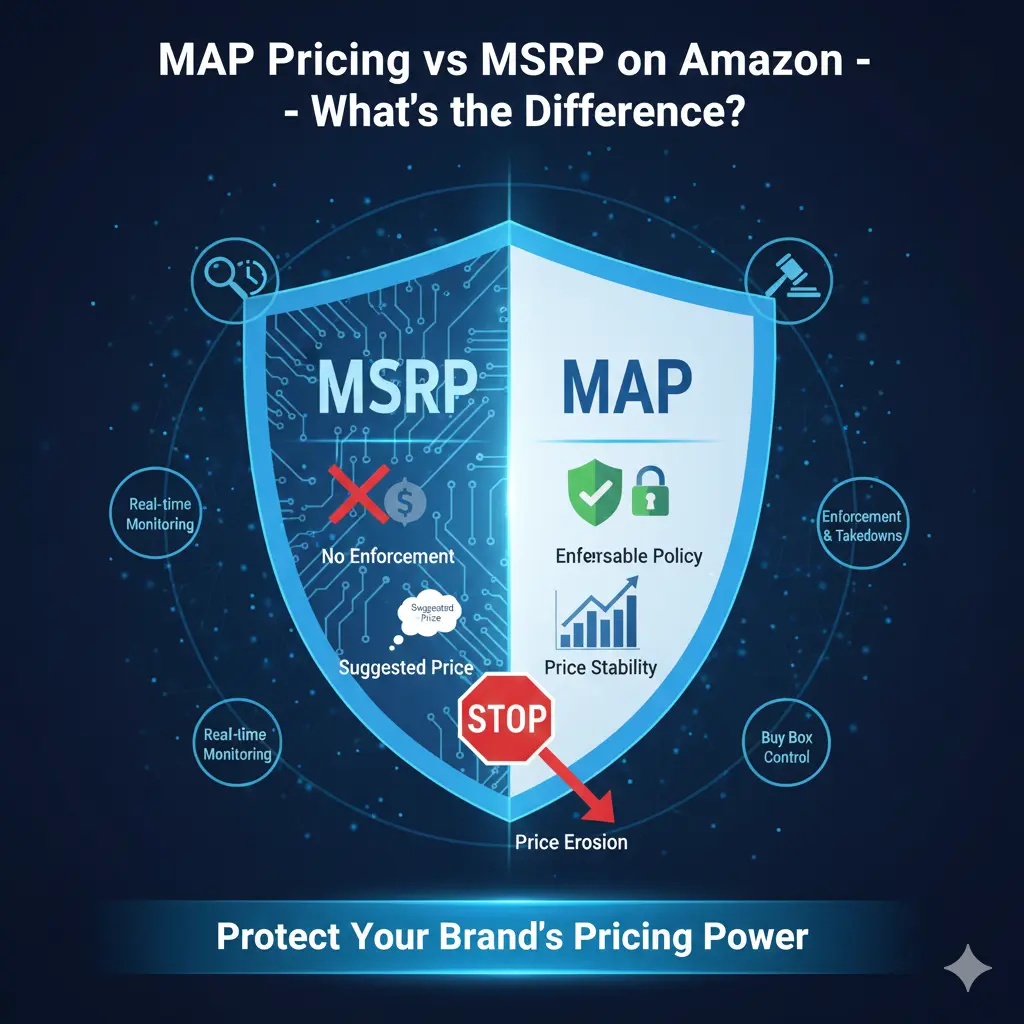
The difference between MAP pricing and MSRP on Amazon is simple, MAP controls the lowest price a product can be advertised at, while MSRP is only a suggested retail price with no real enforcement. MAP is a rule brands can legally enforce on sellers, but MSRP is just a reference point that sellers can ignore without penalty.
MSRP, or Manufacturer’s Suggested Retail Price, is used to indicate the product’s intended value in the market. Amazon sellers are usually free to price above it or below it based on competition and demand. There are no direct consequences for violating MSRP because it is not a binding pricing policy.
MAP, or Minimum Advertised Price, is different because it directly restricts how low a product can be marketed publicly. On Amazon, this affects listing prices, search results, and ads. When sellers violate MAP, brands can take real action, from warnings to cutting off supply, which is why MAP plays a much bigger role in protecting brand value and Buy Box stability.
How MSRP Works on Amazon in Real Market Conditions
MSRP on Amazon functions more like a psychological anchor than an actual pricing rule. Buyers may see the suggested price crossed out next to a lower selling price, which creates a perceived discount, but in practice Amazon does not enforce MSRP. The algorithm only cares about conversion rate, competitiveness, and fulfillment performance.
Here is how MSRP typically behaves in live listings:
| Scenario | What Happens on Amazon |
| Seller prices below MSRP | Listing remains active with no restriction |
| Seller prices above MSRP | Buyers compare and often skip the offer |
| Multiple sellers ignore MSRP | Market price resets lower permanently |
| Brand updates MSRP | No automatic enforcement occurs |
MSRP can help shape buyer perception, but it does nothing to stop price erosion. This is why brands that rely only on MSRP usually lose control of their pricing within months.
How MAP Pricing Is Enforced on Amazon Listings and Ads
MAP enforcement on Amazon is indirect but powerful. Since Amazon controls the public displayed price, any seller pricing below MAP is instantly visible and can be acted upon by the brand.
Typical enforcement workflow looks like this:
Brand detects an advertised price below MAP
Evidence is collected showing time, ASIN, seller ID, and price
Seller receives a violation notice
Repeated violations lead to supply cutoff or legal action
The real challenge is speed. Manual checks miss violations for hours or days. This is where AxleIT changes the game by monitoring every ASIN in real time and generating time stamped violation evidence the moment a MAP breach appears.
Why MAP Matters More Than MSRP for Buy Box Control
If you care about your Buy Box, MAP matters far more than MSRP. The Buy Box is driven by competitive pricing. The moment a non compliant seller drops below MAP, Amazon’s algorithm often favors them instantly.
MSRP does not protect the Buy Box. MAP does.
Here is the practical difference:
- MSRP influences perception
- MAP influences algorithm behavior
- MSRP cannot be enforced
- MAP violations can trigger action
- MSRP allows price wars
- MAP prevents price wars
Brands that actively enforce MAP almost always maintain higher Buy Box stability, better seller relationships, and stronger long term margins.
Common MAP Violations Brands Face on Amazon
Most brands think they only have a few violators. In reality, violations usually fall into these hidden categories:
- Unauthorized resellers dumping bulk inventory
- International sellers bypassing distribution rules
- Liquidators reselling customer returns
- Sellers using coupons to bypass MAP publicly
- Automated repricers racing to the bottom
What makes these violations dangerous is that many of them appear compliant on the surface but technically break MAP rules. AxleIT detects even indirect violations like coupon driven undercuts and suppressed price manipulation that manual checks usually miss.
What Happens When Sellers Ignore MAP but Follow MSRP
This situation is more common than most brands expect. Sellers keep the MSRP visible while quietly advertising below MAP using tactics like:
- Hidden coupons
- Lightning deals
- Multi buy discounts
- External traffic price drops
The result looks like this:
- Revenue drops
- Authorized sellers complain
- Buy Box rotates unpredictably
- Brand trust weakens
- Retail partners lose confidence
MSRP alone cannot protect against this behavior. Only continuous MAP monitoring and enforcement can.
How Brands Can Monitor and Enforce MAP at Scale on Amazon
Manual enforcement works when you have ten ASINs. It fails when you have fifty, one hundred, or more. Scaling MAP enforcement requires automation.
High performing brands use a stacked approach:
- Real time seller monitoring
- Automated violation evidence capture
- Seller history tracking
- Escalation workflows
- Legal ready documentation
AxleIT handles this entire process automatically (book a free demo here). Every price change, every seller, every ASIN is tracked live. When a violation happens, your compliance or legal team receives structured proof instantly, not screenshots taken hours later.
MAP vs MSRP From a Legal and Compliance Perspective
MSRP is legally safe because it does not restrict resale pricing. It is a suggestion only. Enforcing MSRP as a rule can expose brands to antitrust risk.
MAP is different. MAP governs advertised pricing, not actual selling price at checkout. This distinction makes MAP policies legally enforceable in most jurisdictions when structured correctly.
Key legal differences:
- MSRP regulates value perception
- MAP regulates public advertising
- MSRP cannot trigger seller penalties
- MAP can trigger contractual enforcement
- MSRP has no compliance framework
- MAP requires documented proof
This is why every serious brand builds its compliance structure around MAP, not MSRP.
How to Protect Your Amazon Pricing Without Killing Sales
Protecting pricing does not mean killing volume. The strongest brands balance both using three layers of control:
Strong authorized reseller programs
Continuous MAP monitoring
Rapid enforcement with documented evidence
When violations are handled quickly, price wars die before they spread. Sellers stay profitable, Buy Box remains stable, and customers still see healthy market pricing.
AxleIT is built specifically for this balance (book a free demo here). It does not just detect violations, it helps brands enforce pricing without disrupting legitimate sellers or damaging sales velocity.
